
Paddle out at any lineup around Australia at the moment and you will likely come across someone riding a twinny. Listen to the whispers around the surfboard industry and apparently Darren Handley can’t cope with the demand for his double-skegged sliders. Eager to capitalise on the trend, Channel Islands, those bastions of high performance surfing, have also released their own version of the twinny. Meanwhile, Torren Martyn featured in some of the most engaging clips of 2016, riding his quiver of Simon Jones, Morning of the Earth Twins.
So what’s behind our rekindled love affair with the twin fin? Have we romanticized a bygone era and are thus hoping that a twinny is like a time machine that will somehow transport us back to a more idyllic time and place, where things were groovier, simpler and maybe a little more psychedelic? That all we need is a bit of hand jive, a pair of ultra-short boardies, a twinny and some pre-surf, vinyl tunes to psych up with, and we will be back there – ‘Living in the 70s’. Or is the second coming of the twin fin more about having fun on a functional craft while in the midst of a summer swell drought?
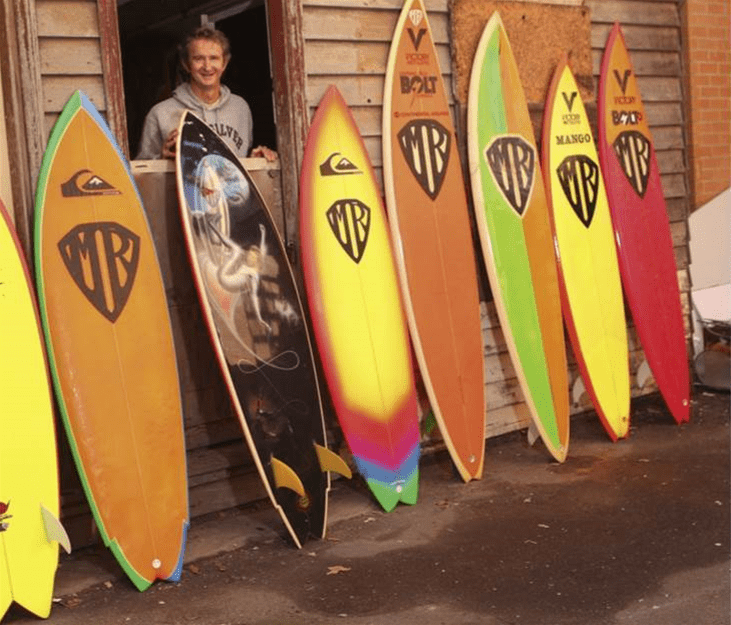
Before becoming overwhelmed with the soulful image of the twinny it’s worth considering the context in which the ‘modern twinny’ was created. After the winter of 1976,1977, Mark Richards returned from Hawaii with a headful of Dick Brewer design inspiration and a singular goal – to make a board that he could win contests on. He had ridden twinnys before but they were flat little nuggets with soft rails and the fins way back – great up to two foot but a little funky when it got bigger. While living above the family surf shop in Hunter St Newcastle, MR, who was already an accomplished shaper, became obsessed with drawing template outlines on his bedroom table. He had painted half his bedroom wall black and he would hang the templates on a nail and analyse the shape while lying on his bed; then wake up the next day and do it again until he was happy with the outline. That’s how he spent his summer before the Australian leg of the tour started in 1977.
MR’s comments below, taken from a recent Tracks piece, indicate how determined he was to build the perfect contest board.
“… It was basically driven by a competitive desire to come up with something I felt I could really achieve a competitive potential on. It wasn’t done because I wanted to do better bottom turns, or get tube rides or hit the lip or anything, it was primarily to try and come up with – for want of a better word – the secret weapon that would help me win contests…”
MR’s bedroom sketches were ultimately responsible for what became known as the Free Ride Twinny. It featured hard-sanded edges from nose to tail, fluted wings, a deep v-bottom, a narrow swallow and a spectacular spray job with a colourful star as the centrepiece. It was the board MR went on to win four world titles on and it became the benchmark design for almost all other modern twin fins.
The point here is that the modern twin fin (much like the thruster) was the result of a ruthless and single-minded ambition to make a functional board that would win contests. Sorry if this spoils the retro soul-trip, but the little history snippet doesn’t mean you can’t enjoy riding twinnys for a whole bunch of reasons.
At a very basic level, the added volume and reduced rocker of a twinny means that they frequently paddle much better than modern short boards. But couldn’t we get the same thing from a fish with three or four fins you may ask? The beauty of the twin fin is that it offers a completely different sensation to any kind of thruster or quad. Until you’ve ditched the back fin and experienced the corresponding absence of drag, you haven’t really lived. Flying down the line on a twinny is one of surfing’s finest pleasures and whether it’s just perceived or real there’s no doubt you feel like you are travelling much faster. It’s a misconception that you need a point break to ride a twinny, a beachie with a bit of wall will do well enough to deliver the addictive hit of speed.
Nor is it essential to ride originals or exact replicas. Many of the latest versions borrow from other evolutions that have been made in bottom contours, rail designs, construction materials and rockers. When the right alchemy between old and new is achieved, twinnys can truly become lively dream weavers – sufficiently loose to create an unparalleled sense of freedom, offset with enough rail bite to ensure you don’t skid out.
Sometimes the initial urge when riding twinnys is to channel some past affectation. It’s fun to make-believe you are starring in your own classic surf movie, but just because you are riding a board that had its origins in another era doesn’t mean you have to pretend you are surfing in it. Watch footage of Rasta, Torren Martyn and Asher Pacey, all of whom ride twinnys almost exclusively, and it’s clear they are riding boards built for high performance surfing.
As for those other less functional elements that seem synonymous with twin fin sex appeal – the resin tints, the decorative sprays and the meticulously created logos (M.O.E boards even have a cool foam stamp); there’s no denying they add to the allure, and transport the surfboard into something, which aims to marry art with perfect motion. Who knows? Maybe a flash looking board is also a psychological asset. When MR made the first Free Ride twinny he remembers spending days spraying the board and cutting out the intricate lettering.
Twin fins will have limitations that most of us can’t overcome in certain waves and it’s not about throwing away the thruster. However, adding a twinny to your quiver can definitely open up another dimension to your surfing. The secret to enjoying them is to get outside the performance paradigm that always has you asking if a board goes better or worse. Instead focus on the fact that it feels and rides in a way that offers a completely different and unique sensation – like something new and exciting to taste. Once you have it dialled, you can choose to chime into that zone any time the conditions seem right.
Perhaps the last word should go to the man who inspired the modern twinny with his pursuit of world title glory. MR is still making and riding magic twinnys, but these days his motives are probably a little different.
“I think it’s great. I love seeing people riding twin fins. I’m really excited that people are rediscovering them because they are a really valid design. When surfing in that 2-5ft region they really go great. Asher Pacey is like the perfect example. He’s tearing on one. Rasta’s on one tearing. They’re not on mine but Mason Ho and Adam Robertson have been ripping on mine. I see Insta clips of them all the time and I’m like, ‘Ripping on a twin fin, stoked to see it.”