
There’s something almost existential about the history of the leggie, not to mention absurdist. (And before we get started, in this most Australian of surf media forums, we are going to call them “leg ropes”, not “leashes”, okay?)
Existential because since the very beginning individuals have had to fight conventional wisdom to exercise their right to tie themselves to their surfboards, or not. And absurd because no other surfing accessory has come even remotely close to inspiring such nonsensical argument from both sides, nor such bizarre consequences from use.
Let’s start at the start, which is a nonsense in itself, since no one really knows who was the first surfboard rider to jury rig some kind of contraption designed to keep body and surfboard together. Warshaw’s Encyclopedia of Surfing credits pioneer surfer and designer Tom Blake with experimenting with a 10-foot length of rope secured between his board and his waist-belt in the mid-1930s, which makes sense given Blake’s obsession with futuristic design concepts and surf safety, and yet there is no mention of such a device in his 1935 book Hawaiian Surfboard, nor in his articles about surf safety in Pan Pacific or other magazines of the period. Possibly, like later leg rope pioneers, Blake found that being tethered to your board did not always have desirable outcomes.
Like Blake, the next surfer known to have experimented with tying himself to his board, some 20 years later, was also a designer of lifeguard devices. Georges Hennebutte, an industrial designer and part-time inventor, first saw a surfboard ridden at la Cote des Basques in Biarritz in 1956. The rider was the Hollywood screenwriter Peter Viertel, who was filming the Hemingway classic, “The Sun Also Rises”, just across the border at Pamplona. Viertel, who was married to the actress Deborah Kerr, was a better writer than a rider, and he soon lost his board and smashed it against the seawall. Hennebutte offered to fix it for him, and he, Michel Barland and Jackie Rott took a plan shape off it, made their own, and became the founding fathers, les ton ton surfeurs, of France.
But Hennebutte’s passion for invention led him to ponder how he could prevent damaging his board on the many rocks and seawalls of Biarritz, and in 1958 he came up with le fil à la patte, the “thread to the paw”, which utilised Velcro straps to secure a length of elastic to his board and either his wrist or ankle, depending on how lucky he felt. Barland, Rott and new ton ton Joel De Rosnay ridiculed him, but Hennebutte persevered alone through the ‘60s.
Meanwhile, in Santa Cruz, California, teenaged Pat O’Neill, with a lot to live up to since his dad had more or less invented the wetsuit, more or less re-invented the “thread to the paw”, using a suction cup on the nose of his board and a length of surgical tubing secured to his wrist. O’Neill’s original idea was that the handheld device would also help push the board through tighter arcs, in which it failed miserably.
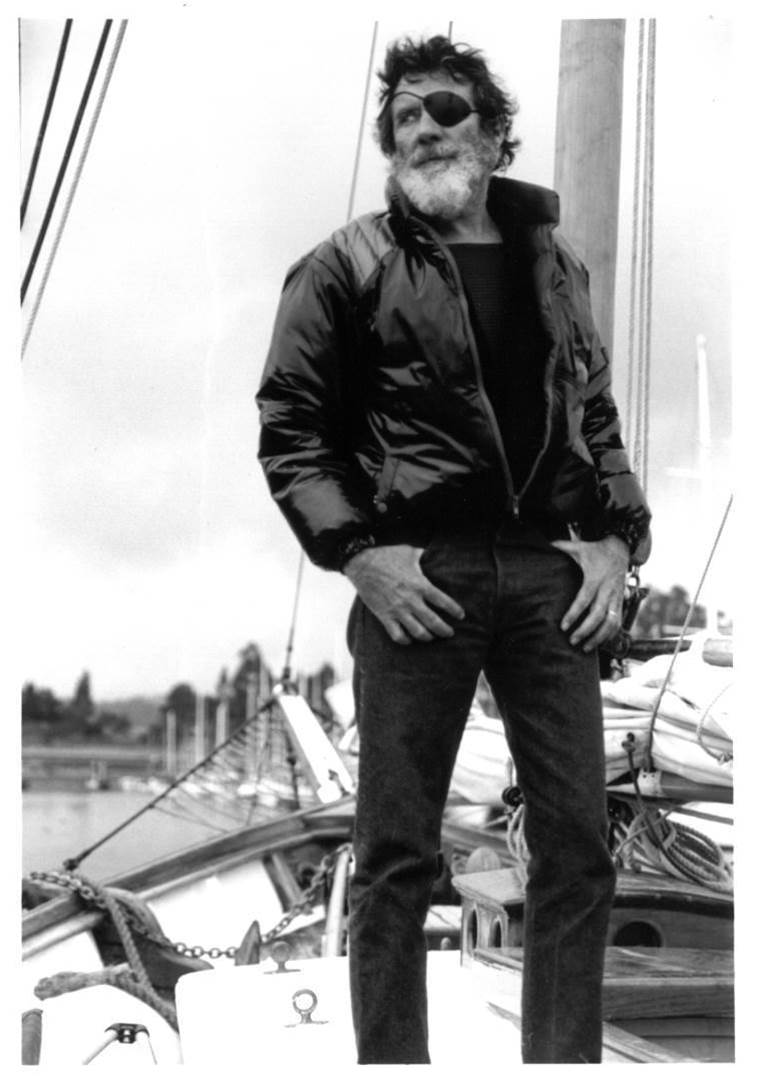
O’Neill soon modified his design to connect ankle to tail, but the project suffered another setback when his dad, the legendary (and recently passed) Jack O’Neill lost the sight of his left eye when Pat’s leggie sent his (Jack’s) board hurtling back at his head at great speed. Would O’Neill have sold so many wetsuits had not Jack spent the rest of his life looking like a pirate? Discuss.
Although Jack O’Neill losing an eye was a crushing blow for the emergent leg rope market, it was by no means an isolated incident, but the mounting evidence that the primitive rubber leggie was a potential risk to life and limb was of only secondary concern to the marketing guys. Their real problem was the same surfing machismo that had plagued M Hennebutte for the previous decade – leggies were for kooks and nancy-boys. Good surfers didn’t need them.
The leg rope was first manufactured in Australia by Bob Newlands’ Surf Aids company in Byron Bay in 1973, and while there were no doubt plenty of early adopters, I had never seen one when I left that year for my first overseas surf trip, and I never saw one while surfing from Cornwall through France, Spain and Portugal.
Still blissfully ignorant of the kook cord, I arrived in Bali the following year and noticed, as the entire crew of our Rip Curl surf tour prepared for a first surf, that I was the only one without the means to attach himself to his board. Within 24 hours, and before our first bemo ride to Uluwatu, I had turned that around.
I was also present at the Alan Oke Memorial Contest on Phillip Island that, concluding at a particularly hazardous righthand slab, went down in history as the last Australian surfing event to ban leg ropes. Until now, that is.
Which brings us full cycle, back to the future, with bushranger-bearded and leggie-less loggers evoking strong emotions at crowded summer surf spots, while in many logger comps the leg rope is as taboo as hard rails and side fins. In the blogosphere the argument runs back and forth, hot and cold, flaring every time a child cops a loose board in the moosh. And when that happens, it’s hard to argue against attachment.
But here a confession. Having begun my surfing life leggie-less, I am now ending it the same way. Why? Just put it down to the absurdity of an old existentialist.