I toughed it out for a month of Argentine winter surfing, which was about as much character-building as I could tolerate, so I came back to the city and decided that, if I wasn’t going to be in the water, I’d follow surfing’s cooler, younger, slightly more delinquent brother: skating.
When I was younger, skating had me by the throat. Then I broke my arm one too many times bouncing off concrete and came to the fairly obvious conclusion that water was a softer, more forgiving place to make a fool of yourself. For the past two years I’d had surf blinders on: beach towns, waves, groms with a good story. Repeat. I could be miles from the water and still be figuring out how to make a story interesting to surfers. It had become a condition.
Coming into surf communities can be a bit touch and go, especially in the city. And in any situation, there are few things more effective at making you feel like an imposter than walking into a skate scene with a notebook and admitting you’re usually running with the older brother that steals their thunder. You might as well arrive at a family dinner wearing a wire.
But the transition was surprisingly painless. I walked across the hall, knocked on the door and asked to be let in. They obliged. I stood there for a moment, suspicious. Was I about to walk through the doorway and have a bucket of slime tipped over my head? Was there some elaborate initiation ritual I hadn’t been briefed on? No.

The guy holding the door open for me? Gael Dobar.
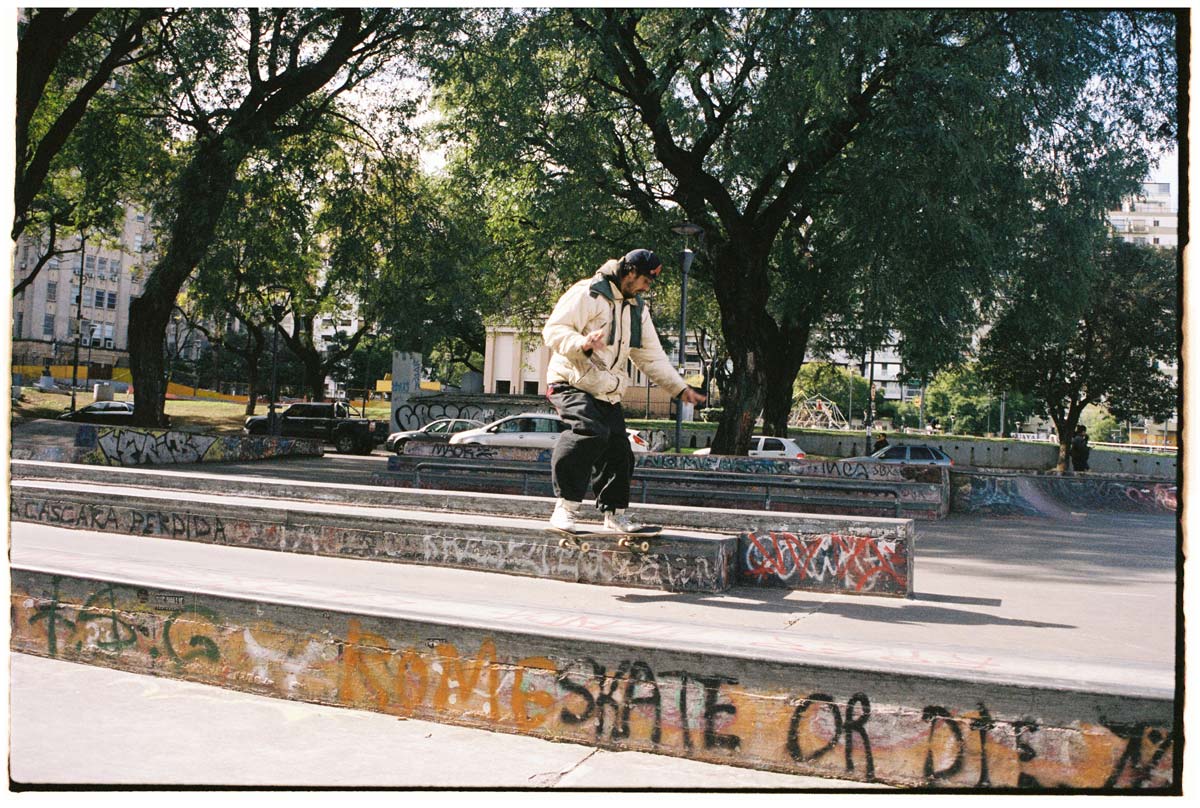
Gael is, as far as I’m concerned, the best skater in Buenos Aires. This isn’t bias. If anything, it’s an unnecessarily modest opinion.
The first time I met Gael, he was 45 minutes late and my phone was sitting at a reassuring 12 per cent battery.
He was wearing a black-and-white striped top emblazoned with the words SKATEBOARDING IS NOT A CRIME, which is true, although his punctuality was beginning to look fucking criminal.
When he eventually appeared, he introduced me to a few friends at a little café-clothing shop poking out from the side of the wall, squeezed between corporate buildings and men in shirts marching towards offices they presumably hate. There was a small bench outside, just big enough for all of us. We smoked rollies, drank coffee and talked shit before heading to Plaza Alemania.
On arrival, we were immediately ambushed by a gang of tiny dogs.
Just a furious little militia of ankle-height terriers yapping around our boards as though we’d arrived to repossess their land. Their owner eventually came over, not to apologise for the canine uprising, but to warn us that we needed to be careful skating around people.
I looked at her dog, still in a one-sided argument with the board under foot. My eyes rolled, a smirk grew, and I felt like saying: you worry about your dogs, I’ll worry about mine.
Once the canine diplomacy had concluded, we got on with what we came for: skating.
Gael was shooting for a friend that day, and almost immediately he disappeared into his element. Or perhaps more accurately, became the person he has been constructing all along.
A couple of days later I dragged along a friend who knew absolutely nothing about skating and cared even less to meet Ignacio, a fairly important photographer in the Buenos Aires scene.

Naturally, while we were waiting for him, my camera decided to fall apart.
The lens had somehow unscrewed itself, something I didn’t previously know a camera could do. The focus was fucked, my favourite camera appeared to be dying, and I was doing that particular kind of silent panic where you try to look like a functioning adult while internally pricing a funeral.
Then Ignacio arrived.
He had Wolverine sideburns, although he insists he had them first. I chose not to challenge him on this. There are some battles you don’t need to fight five minutes into meeting someone.
I slipped Gael into the conversation early on, which seemed to be my passport into a genuine conversation.
Ignacio had known him since he was a kid and loved him. Not just because of the impressive skate skills, but because he could see what Gael was becoming. A skating Lou Reed of sorts.
Ignacio spoke of Gael less like a skater and more like a subject. He noticed the things you might miss if you were only watching for the trick: the clothes, the way Gael carried himself, the places he chose to skate, the people around him. He understood that Gael was building something around the skating.
I’d met Gael as this fully formed character, confident, slightly chaotic, very good on a skateboard. Ignacio had seen the evolution of him, from kid on a board to someone who understood that being a skater could mean much more than skating.
The funny thing is, Gael doesn’t really need to work on his skating. He seems to know what he wants to do and how he wants to do it. The interesting part now is everything around it: folding photography, video, clothing and all the other visual debris of a skate scene into something that feels entirely his.
From Ignacio’s perspective, that was what made Gael interesting. Not just that he could skate, but that you could point a camera at him and, somehow, there was already a story there.
A couple of days later I met up with Gael again. We sat in a café drinking coffee while water plagued the pavement. Eventually we’d occupied the café so completely it stopped feeling like a café and started feeling like our lounge room. A couple coffees and a cigarette, we behaved as though we paid rent.
We ended up at El Mazacote for a late dinner, the sort of place that looks as though it has been feeding Buenos Aires since the city was smaller.
I was waiting on the corner when I heard Gael coming down the street before I saw him. He’d had a big day skating. He was scratched up, sore, and the nose of his board looked as though it had been dragged behind a car.
El Mazacote was packed. Mostly families, old couples, people who looked as though they’d been coming there longer than either of us had been alive. There was nothing fashionable about it. It looked like my grandmother’s dining room, which is probably why it was so good.
We stood at the counter and ate. The guys behind it poured us white wine until the glasses were practically threatening to overflow. No measurements, no ceremony. Just wine right to the fucking rim.
We talked about the industry, Latin America and the strange little ecosystems you find yourself in when your job involves people who obsess over very specific things.

When we finished, Gael went back to the pizza guys to tell them how much we liked the food. He seemed genuinely concerned that they knew. Before we left, he got into a serious conversation with an older man. I watched, wondering what they could possibly have in common. Eventually I caught the last part. “You either get on the train when it passes, or you watch it pass you.” Gael held this kind of intensity that made conversations like that feel completely approachable, even for a stranger.
The last time I saw Gael was at a DC kids’ event. We were running late, naturally. Paris smoked a joint while we drove out towards the DC store, which seemed like an appropriate way to arrive at an event designed to teach children the virtues of skateboarding.
When we pulled up and crawled out of the back seats, I looked up. Above us was a giant billboard of Gael skating a bowl. I pointed at it, smirking. “It’s you.” He hadn’t seen it before. And then something happened to his face. The persona disappeared. The Lou Reed cool, the hard exterior, all of it just fell away. For a second he looked like a kid who had just discovered himself on a billboard.
He spent the afternoon doing demos for the kids, throwing himself around this ridiculous half-pipe with a megaphone in one hand, skating with the kind of ease that makes something incredibly difficult look mildly recreational. He seemed genuinely happy to be imparting wisdom.
At the end, the kids lined up to get their boards, helmets and shirts signed. One girl passed him her helmet to be signed and then as she walked away she licked her finger and tried rubbing it off, the black sharpie didn’t quite go with her fairy floss unicorn attire.
We asked a guy if Gael could stand on the roof of his car so we could get a decent photograph with the billboard behind him. And once the event was over we got a few shots of him doing the trick he’d been thinking about all afternoon in the half-pipe.
Somewhere in between it all I felt a bit like I was the only stationary thing in the room, and everything moved around me.
There are moments when being an observer doesn’t feel like being an outsider. It feels more like being temporarily entrusted with something. You don’t want to interfere with it or explain it too much. You just want to stand close enough to feel the heat coming off it.
For a few hours, I got to really observe it as it was. Just Gael, grinning at a bunch of kids, skating until he was exhausted. I didn’t want to interrupt it. I didn’t want to pull it apart looking for a story or turn it into something neat enough to put on a page. I just wanted to stand there and let it happen around me. And it was one of those moments you know you’re lucky to have been allowed into precisely because you’re afraid that touching them might make them disappear.
And in the end, a part of me thinks I chose the wrong brother to run after. I might have broken a few more bones, but I know I would have been hugged more.
That was the biggest difference I noticed between surf and skate. After a good run, everyone hugs everyone. The win belongs to the whole circle, not just the guy who landed it. Maybe surfing can learn a little something from its little bro.