Over the past half century, Sid Abruzzi has fostered a hardcore surf community under the banner of Water Brother, one of the world’s oldest underground surf brands, in his hometown of Newport, Rhode Island.
Sid is very much a surf, skate icon and is considered a core legend. A new film documenting his life is now being launched this summer. WATER BROTHER: THE SID ABBRUZZI STORY features a mix of never before seen archival film, large format cinematic footage and interviews from people like Tony Hawk as the film aims to take viewers through surf and skate history from the 1960s onwards.
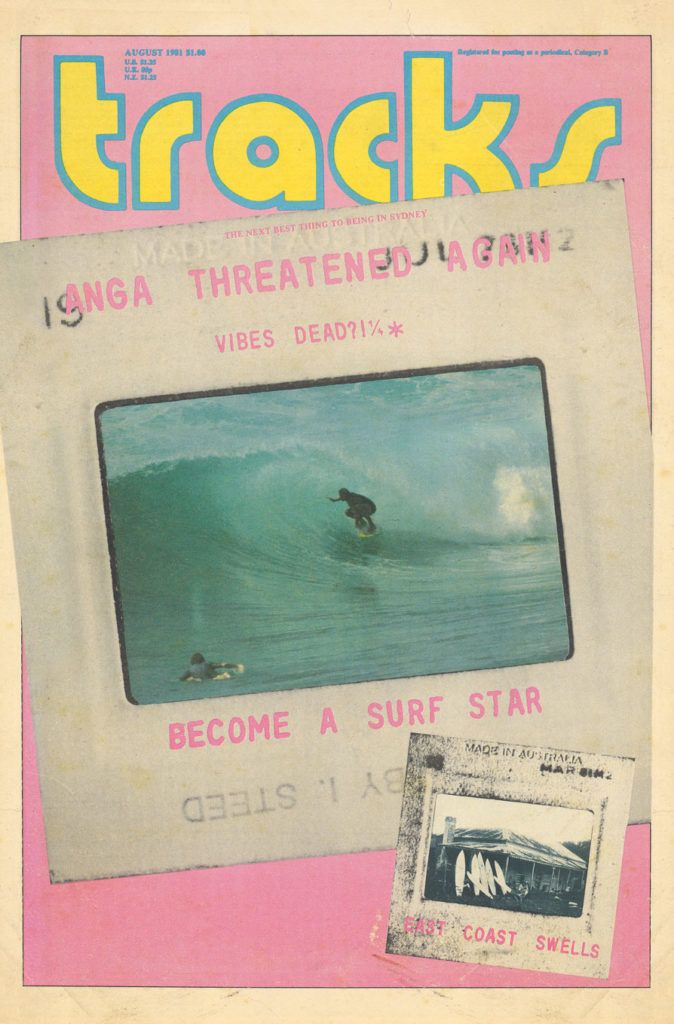
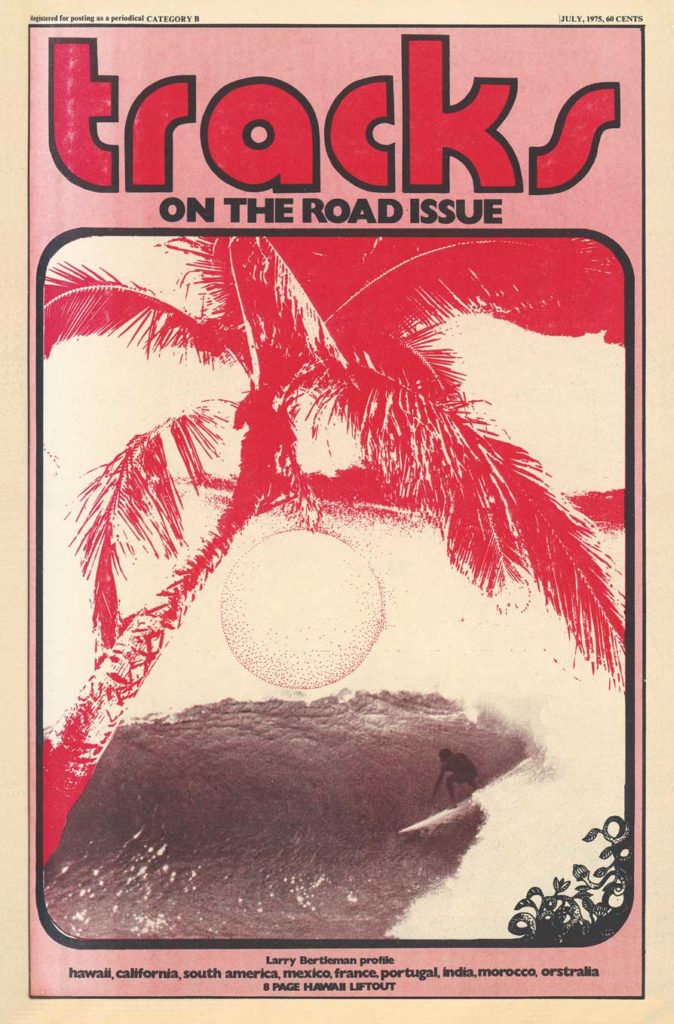
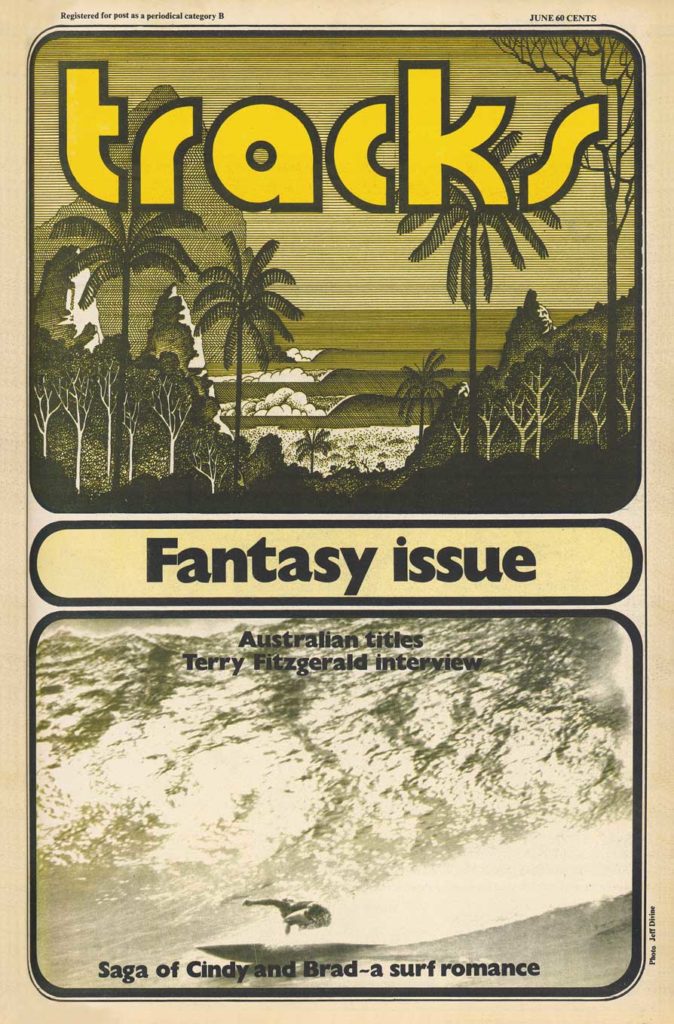
We thought this was the perfect opportunity to share a feature we ran on Sid in Issue 587 of our mag. Below is the first part of the feature and the second part will be released later this week.
SID LIVES: THE NINTH LIFE OF THE LAST ORIGINAL – written by Tony John Andrews
I got big news,” Sid says. His voice is hoarse, nasal, regionally northeastern. He talks with his gnarly, tatted hands, arms spread wide like he’s holding the news.
It’s not an unusual thing to hear him say. In the way of all incorrigible dreamers, Sid always seems to have something ecstatic looming on his horizon. Over the past half century, he’s fostered an improbably hardcore surf community under the banner of Water Brothers, the world’s oldest underground surf brand, right here in his hometown of Newport, Rhode Island, a place not known for its waves. Along the way, he’s broken bread (and bottles) with surf & skate royalty, holding basement jams with Tom Curren’s Skipping Urchins and halfpipe sessions with Tony Hawk. He’s even dipped a toe into the mainstream; Bill Murray once made head-lines at Cannes by wearing a madras blazer he got from Sid.
But this big news feels different. There’s a special intensity to Sid’s eyes, sparkling darkly beneath that mischievous brow.
“BIG news,” he repeats. He emphasises keywords when he’s pumped. Sometimes his voice fully cracks from the strain, the cost of a lifetime of screaming across waves and offramps and into microphones.
“What is it?” I ask.
“I couldn’t believe it at first,” he rasps. “I thought it was an April fool’s joke.”
It’s April second in Newport, the preposterously quaint seaside town best known for the Gilded Age mansions that loom from its cliffs. The trees are still barren, but a warm sun sharpens the pastel colonials lining the cobblestone streets. Daffodils bloom across from Sid’s little black shop, an oddity against the waspy milieu.
“On May third…” Sid holds up three fingers, index bent wildly to the side from an old pickup football injury. “I’m driving to the private airport in Quonset — well, I’m not driving, I’m getting picked up — and I’m flying out to…KELLY SLATER’S SURFRANCH!!!”
It’s bigger news than I could’ve imagined. I’ve been following Sid for the past several months to profile his off-the-map life. 2021 isa triple-milestone year for him. He turns 70 in August, and Water Bros turns 50. It’s also the 50th anniversary of his notorious arrest. But the Surf Ranch is the most talked-about wave in the world. The story is now.
“Look at this freakin’ place!”
He whisks me past racks of punk-themed merch to the flatscreen on the shop’s backwall. Fiddling with the remote, he pulls up a clip of the pool mass-assembling flawless blue waves.
“Runs for 2,000 feet. Overhead. Tube section, open face, the works. Rides over a minute long. Costs 50 grand a day. A wave every four minutes. 120 waves a day. Over $400 a wave.”
Turns out a friend of Sid’s knows one of the Ranch’s part owners, an ex-Goldman Sachs guy with Newport ties. Together they’ve arranged to fly Sid out for three days, May 3rd through the 5th, free of charge. To afford the trip otherwise, he’d have to liquidate the family home.
“Heard it SLAMS ya though,” he cautions. “It’s coated in cement or whatever. I heard one guy broke his shoulder.”
“Be careful,” I say.
“I’m so nervous,” he admits, sober for a moment before his smile cracks open again. “Trip of my life! I can’t believe it. You’re like the first person I’ve told.”
I offer my congrats. But as euphoric as this news is, there’s a cruel irony underneath it. Sid’s nota young gun anymore. And in his nearly seven decades alive, he’s shredded his way to that broken finger, a “bad” shoulder, several smashed ribs, a punctured lung, uncountable stitches, three surfer’s ear surgeries, many episodes of drink and drug-induced hell, and, most recently, the progression of widespread arthritis, which necessitated both right and left hip replacements in the last five years. For the bulk of his life, Sid has lived by the ethos of “rip, tear, and lacerate,” and it shows on his medical chart. There’s a sense in which it’s less amazing that he’s still standing than that he’s still alive.
It’ll be sad if Sid struggles to surf well and is made to face the limits of his age, but better that he injures his pride than his body. In the worst-case scenario — God forbid — he could break his collarbone, hurt his neck or back, or smash his head on the wave pool’s concrete floor.
Sid sits down and rubs his knees absent-mindedly.
“I’ve got 30 days to train,” he says, staring off.
“You’ve got this,” I say.
I wish him luck and turn to go.
“Hey!” he calls out.
I look back. “Yeah?”
“Does it smell like pizza in here?”

2. Of Big Fish and Small Ponds
The odds seem long, but if anyone can comeback to ride the Surf Ranch at 70, it’s Sid. His surfing life was not handed to him. At every turn, he’s had to wrest it from fate’s grip, surmounting a battery of obstacles. Chief among them? Simple geography.
“I can’t even tell you how many people think Rhode Island is a part of New York,” Sid says in the teaser to Water Brother: The Sid Abbruzzi Story, a long-time-coming documentary about his unlikely life. “And I’m there like, no, we’re a state.”
Even if you’re among the rare few cartographers who knows Rhode Island from Long Island, if anything comes to mind when you think of RI, it’s probably not surfing. And fair enough. This is not Oahu’s North Shore. The coastline is craggy and harsh, the winters arctic. Swell windows are brief, hinging on rare, fickle storms. Most days are flat. Most rideable days offer weak slop. Surfing in RI is at worst a fool’s errand, at best a labor of love. Sid’s commitment to building a surfing life here, before leashes or winter wetsuits, when surfing was barely a gleam in the business world’s eye, makes almost zero sense. Put another way, it suggests a level of love that has no conditions, the kind we call “true,” in desperate search of which so many of us wander around lost our whole lives.
Perhaps that’s part of why he’s so revered, and why the word ‘legend’ invariably follows mention of his name. Despite his niche domain, his reputation is mythic in the global surf underground, having spread across decades of couch surfing his way to some of the world’s best waves in their heyday. In Cocoa Beach in the 70s, he befriended east coast champ, Mike Tabeling, and watched in awe as a nine-year-old savant named Kelly humbled grown men at the old Sebastian Inlet. In the 80s, he wintered in Santa Cruz, where he worked for board smith Tom Overlin, sharpened his fore-hand at Steamer Lane, partied with Christian Fletcher and Jason ‘Rat Boy’ Collins, and forged a link between Newport and SC assister surf cities, with their twin cliff break setups. He spent several years in the early 90 sat Tabeling’s house in J-Bay, where he became neighbour and friend to a finless free-thinking Aussie named Derek Hynd. But even in the most iconic lineups, among the most eminent peers, he always made a point to tell of Rhode Island and its waves, becoming in effect a kind of informal ambassador for this way of living in this place.
“When you look up surfin’ in Rhode Island in the dictionary, you see a picture of Sid Abbruzzi,” said a longtime Newport local. He obviously meant it figuratively, but it’s pretty much literally true as well. The Encyclopedia of Surfing has a lengthy entry on the East Coast Surfing Hall of Famer, one of the many honorifics he’s amassed along his way. In 2002, Juice Magazine epically crowned him, “The Godfather of the New England Surf & Skate Mafia.”He was recently named one of the 50 Greatest Living Rhode Islanders, certifying his oddly paradoxical microcelebrity status. Indeed, Sid is a man torqued in contradiction. He’s the biggest figure in the fringiest sport of the littlest state, owner of the coolest surf brand you’ve never heard of; a household name in a house where no one lives.
He has gone by many names. His most-invoked nickname is ‘The Package’, which he insists is not a phallic boast, but a reference to the unholy trinity he prays to: surf, skate, rock ‘n’ roll. The total package. Some call him Johnny Morocco. I received no explanation for this. His younger brother, Christopher, who himself goes by Magoo (everyone has a nick-name in Sid’s world), refers to him affectionately as Sidney. But most people just call him Sid, though he wasn’t born with the name. Sidis something he became.
Stephen Anthony Abbruzzi was maybe 13,ordering with his friends from the hotdog window just two doors down from where the shop stands today, in what’s now the gutted out remains of Jimmy’s Saloon, when a drunk stumbled by and pointed straight at him. “Hey, that’s my good buddy Sid!” slurred the wasted stranger. It stuck. Who can say if the name makes the man or if the man makes the name, but there’s no doubt that ‘Sid’ captures something his birth certificate never could. The hissing, opening ‘s,’ the thudding, terminal ‘d,’ the punkish androgyny, the crude monosyllabism — it’s the perfect lingual totem. “Do you like your name?” I asked him. “Yeah,” he replied. “I’m Sid.”
But who is Sid? I wanted to know. I wanted to get inside the mind of the man and past the vague invocations of his ‘legend’. I wanted to study the myth, to be able to recite it by heart and learn the lesson it had to teach. In the process, the theme emerged of sheer, dogged force of will, which, depending on how you slice it, appears either visionary or delusional. I mentioned that surfing in Rhode Island is hard, but it used to be illegal.

3. Surf Outlaw
Flashback to Newport, 1971, and Leo Donovan is pissed. He recently landed a cushy new gig as caretaker to the Anglesea Estate, a sprawling clifftop Victorian at the end of Ruggles Avenue. Set to spend the rest of his days sipping fine wine by the Atlantic, he thought he’d finally arrived. But that young punk Sid and his deadbeat friends are shattering Leo’s fantasy. Whenever the surf roars, they screech up in a beat-up Ford Falcon, hooting and hollering and — the indecency — changing outside and tarnishing his view of the sea with their treacherous surfing boards.
Of course, Leo doesn’t own the sea. No one does, despite the best efforts of the mansion-dwelling class. And he has no clue that right below the estate, ever since the glaciers carved out this coast and sculpted the reef in just this way, when swell and wind and tide align, a gorgeous right-hander peels off the rocks and wraps around the cliffs. This is a precious natural site. And that longhair ain’t no punk, at least not in the way Leo means. He’s a ragtag pioneer of shortboarding at Ruggles.
Problem is, Leo has the law on his side. A city ordinance bans surfing off the cliffs, the rumored work of the chief of police, who fishes at the point, in response to a longstanding feud between fishermen and surfers, so old that no one can remember how it started.
Glaring down from the estate window, Leo rotary dials the cops, who arrive brandishing megaphones and call the riff raff out of the water. Begrudgingly, the boys obey. But when-ever there’s swell, they return. When the point is firing, they can’t not surf it. Each time, Leo calls the cops. Sessions are cut maddeningly short. Perfect sets roll by unridden.
Tension mounts. Checking the surf one night, Sid hears the crack of a single gunshot reverberate from the estate grounds. Driving to Ruggles one morning at sunrise, he notices an eerie glare up ahead. The Avenue is caked for 50 feet in broken glass. The cops suspect the young punk kid.
“Look at the labels!” he tells them, indignant. “You think we drink $400 bottles of wine?”
Under a blue October sky, Sid, his little brother Magoo and their buddy Bob have blustery, five-foot Ruggles to themselves. As always, the cops appear. But this time, Sid has a plan. Instead of climbing out at the end of the ride, he paddles back out to the break. A megaphone threatens to tow his car.
“Take the car but leave the surf racks!” the boys yell back.
Bob loses his nerve and flees. It’s just the Abbruzzi bros now. They surf lap after lap, in and back, for hours as the squad cars mount. The sun dips low. The air turns cool in the shadow of the cliffs. Finally, Sid and Magoo —noses red, mouths parched, shoulders torched— relent. You can’t surf forever.
The cops let Magoo, just 17, go. But Sid’s 20, so they make an example of him. He’s arrested and fined $10. He appeals, wears a suit to court but doesn’t cut his hair. In an unexpected twist, the system is sympathetic. Judge Carrellas must have been a surfer in his soul. He not only acquits Sid, but overturns the surfing ban, legalising Ruggles to this day. Three years later, the judge’s grandson will be one of the best young surfers at Ruggles, riding a board he bought from Sid. Also in the future, Sid will bump into Leo at Dunkin’ Donuts, and Leo, now mellower, will say hello.

4. The Face that Launched1,000 Spliffs
In the aftermath of the Ruggles trial, Sid embraced his new surf outlaw rep and fashioned himself in its image. History aside, there’s no doubt that a significant portion of his intrigue is visual.
“I mean, just look him,” says Nick Carrellas,32, grandson of the judge who acquitted Sid. David Lee Scales, host of the Surf Splendor podcast, has remarked of Sid’s appearance: “He looks like someone who’s actually lived.”
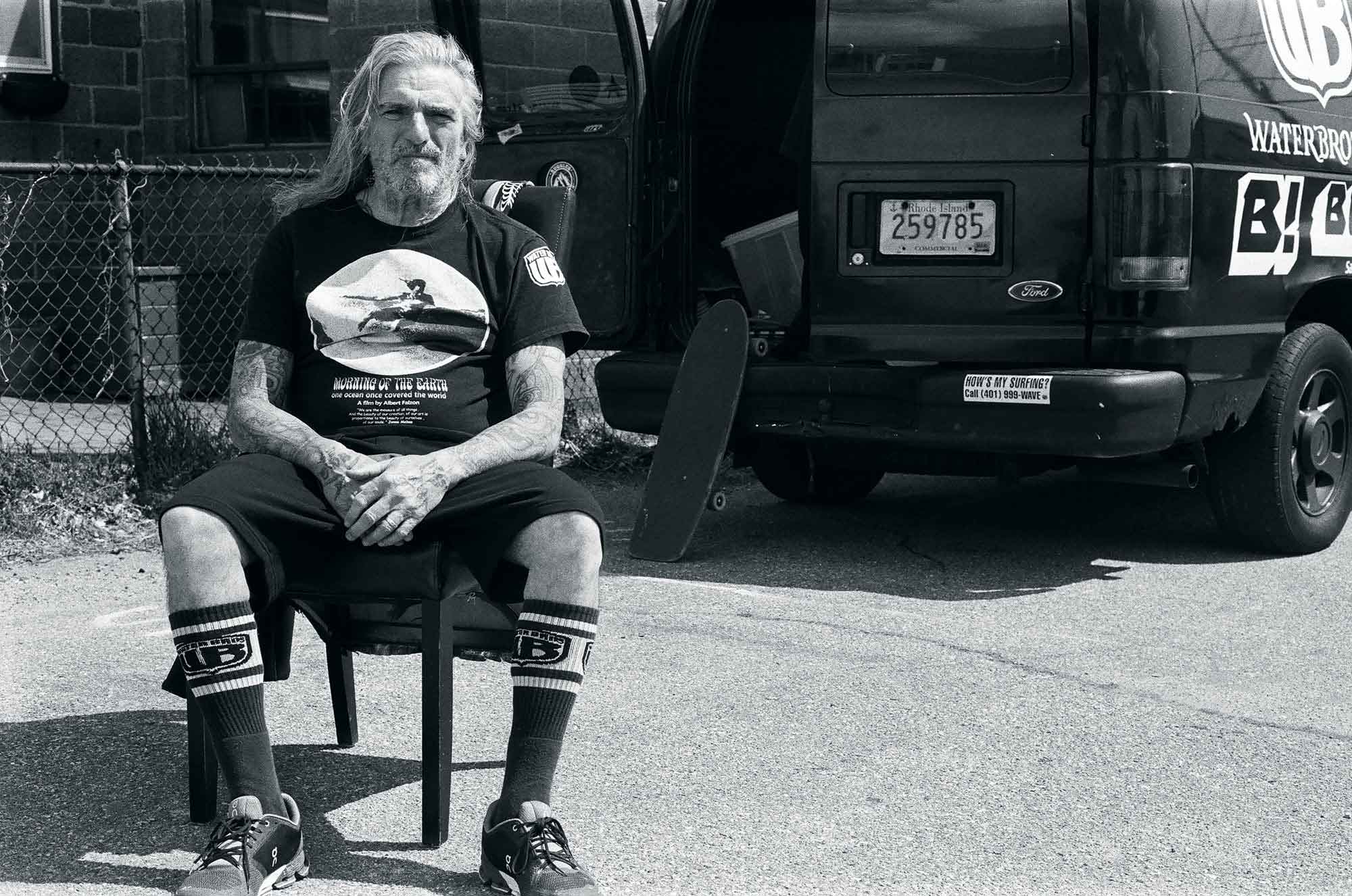
Despite the wear and tear, Sid has kept in remarkable shape. He is ropey and lean. He moves well, if with a subtle hitch to his walk. The slight, inevitable old-guy gut seems a fair price for old-guy strength.
“Don’t tell my doctor or my wife. They’d kill me,” Sid warned. “But I’ve been running again. 3-4 miles, 5 mornings a week.”
His hair is — there’s no other way to put this —magnificent. Silver-white, middle part, streaming to the shoulders in neat, impossibly soft-looking locks. There’s no finer pelt on a man his age who isn’t a fictional wizard.
In an interview intro, Scales pretty much nails Sid’s appearance as a cross between present day Sean Penn and Robert de Niro — pursed lips, creased brow, roman nose — but with long hair and full tattoos. In short, an Irish-Italian American surf-rocker pirate; ‘100%Surfer’, reads the top of his left foot in metallic blue; ‘100% Skateboarder’, answers his right in flaming red. The ink fuzzes snakelike down his arms, drips from his sleeves, knots of prison bars and tongues and skulls. Sid’s tattoos are an inseparable part of his rebel mythos, but when I ask him about them, he rolls down his sleeves, says he doesn’t want to talk about them, wishes he never even got the min the first place, as if they read to him like water-stained notes from a part of his past he’d rather not remember.
“You’ve got to understand,” brother Magoo told me over a beer. “He’s a different person now.”

5. Sid’s World
“I want to come back to be the greatest 70-year-old shortboarder alive,” Sid told me, dead serious.
“Ooh, I’m gonna give him shit for that!” relished longtime friend Benny ‘Dead’ Landers, 67 and wearing a Ghost Face Killah Tee, when I relayed Sid’s goal.
“I mean, more power to him,” said Justin Casey, 43, a stoic carpenter/family man who holds down Ruggles at triple overhead. “If anyone can do it, Sid can,” added Casey, but I heard reticence in his voice.
It wouldn’t be the first time Sid has set himself apart. I spent a day with him last winter at Original Water Brothers. He’s been running the homegrown surf shop nonstop for 50 years— mostly. The ‘Original’ part is a nod to the shop’s many iterations in its ongoing battle to stay open, and though “surf shop” happens to be the simplest descriptor, in almost every way, Water Bros subverts the standard expectations of the retail shopping experience.
Instead of merchandise, the window display features a diorama of what can most succinctly be described as a surf-pirate zombie apocalypse. The interior feels less like a store than a museum of Newport surfing culture, inspired by the town’s seafaring past. Beneath the bamboo roof, the walls brim with a mishmash of surf paraphernalia and nautical kitsch: colorful antique surfboards, wooden skateboards with clay wheels, a Great White jaw, a pirate ship wheel, a golden trident, the skull of a boar. An antelope head keeps watch above the door frame in the back. It’s Hemingway meets the Sex Pistols: a marine-punk mancave.
The whole enterprise is terminally old school. Water Bros doesn’t have a website. Sid takes orders by phone, records them on post-its, and ships by hand. In the broom closet, atop a folding chair, there’s a dusty old answering machine. Every morning, Sid dials in and rattles off a surf report in the cadence of an old timey sports announcer. You can call 1-401-848-WAVE (9283) to hear it right now.
You will not find corporate surf apparel at the shop. All Water Bros wear — t-shirts, hoodies, boardshorts, etc. — is signature and of unusual imaginative richness for a store so small, including custom designs by Shepard Fairey from his time in the RI skate scene. Consistent with the primary “WB” logo, a visual pun on the Warner Brothers emblem, the brand’s graphics depict a universe of degenerate surf& skate Looney Tunes: a demented skull with surf fins for horns, a cockroach dropping into a nuclear wave, a two-headed luchador surfing through a Great White jaw.
The clothing is tag-less, and all designs and colors mix on the racks, which gives the store the feel of someone’s closet. There’s a stack of brown grocery bags behind the counter should you ask, but otherwise you walk out with your purchase in hand, as if it was always yours.
Buy something, don’t buy something. Sid doesn’t seem to care. He might not even say hello when you walk in. Despite his larger-than-life image, his affect is actually somewhat reserved, his eye contact, infrequent. “Shy” was the first word Magoo used to describe him. His magnetism seems to come less from extroversion than sheer authenticity.
“It’s like an animal in the zoo,” quips Danielle, 47, Sid’s wife of eight years. “He’s just doing his thing. People go to watch him. It’s a cliché, but with Sid, what you see really is what you get.”

What you see is Sid sitting back to the store-front window, shooting the shit with the regulars. Or watching surf videos past and present: from old Super 8 footage to live WSL contests, of which he’s a die hard fan. Or fixing a local kid’s Wal-Mart skateboard, then waving the kid away free of charge.
That’s another thing about Sid: The man is notoriously generous — some say to a fault. Take for example Nick Carrellas, who remembers being nine when Sid sold him his first board, a 5’6” Pearson Arrow with Hot Wheel flames down the rails. Sid slashed several hundred dollars off. “Yer on the team!” Sid informed Nick, waving off his dad’s protests. “Just don’t tell anyone,” he winked.
But all of Nick’s friends already knew because they were all on the team. They were the local groms who lived and breathed surfing, and Sid nurtured their obsession with half-priced merch, even when he was out of a shop, running pop-ups in his backyard to keep the brand alive. When winter wetsuits came in— a must for surfing through the bitter New England winters — he sold them to the crew wholesale, eating the cost of shipping himself.
In the day I spent at Water Bros, Sid had a single customer: a college-aged woman who bought a hoodie. But the shop wasn’t empty. Neighborhood kids rambled in, skateboards under arms, and wandered around agog. A self-proclaimed “surf mom, not soccer mom” asked Sid’s advice about safety gear for her kids. A man who looked hard-lived, clothes tattered, walked up and placed a single apple on the counter as an offering to Sid. He was one of several down-and-out-looking people who came in that day to say hi.
“A lot of loner people that might have problems, maybe battling addictions, they get some sort of connection,” mused Benny Dead Landers. He rarely leaves the house except to go to Water Bros. “Sid’s helped people feel like they belong to something when they don’t have anything.”
Water Bros seems less a store than a community hangout, the kind of gathering space people yearn for. But it might not be around much longer. Authenticity, charity, and community don’t pay bills. Sometime this year, Sid’s shop will be demolished and replaced by a boutique hotel. If COVID hadn’t stalled demolition, the store would already be dust. As rents climb, the odds of Sid finding another affordable lease dwindle. He’s hoping for one more Christmas season, but construction could start as soon as this fall.
Perhaps Sid sees the Surf Ranch comeback as a means of wrenching control from an uncertain future, something to look forward to, a goal to chip away at each day. His office is cluttered with fitness gadgets — the latest resistance bands, foam rollers, and exercise balls — freshly opened from the Amazon boxes daily arriving at the shop, and he’s been following Mick Fanning’s workouts on YouTube. He hopes these things, along with his jogging routine, will help him restore the pop-up speed he’s lost, but there’s no replacement for time in the water, and April has been unusually flat — even by RI’s standards. Sid’s daily surf hotline becomes an oral catalogue of the long, gnawing wait:
Thanks for calling on a cold, cold, flat. F-L-A-T FLAT, meaning no waves, Thursday…
…Foggy out there today…but of course the waves are flat. Red Sox are winning but…let’s have waves…
…Surf conditions flat, six inches, onshore chop, rain. So….pretty ugly, put it that way…
…I wish I could tell ya there’s a waist-high swell out there because there’s a perfect offshore wind, but it ain’t happenin’…
…Fuhgeddaboudit.