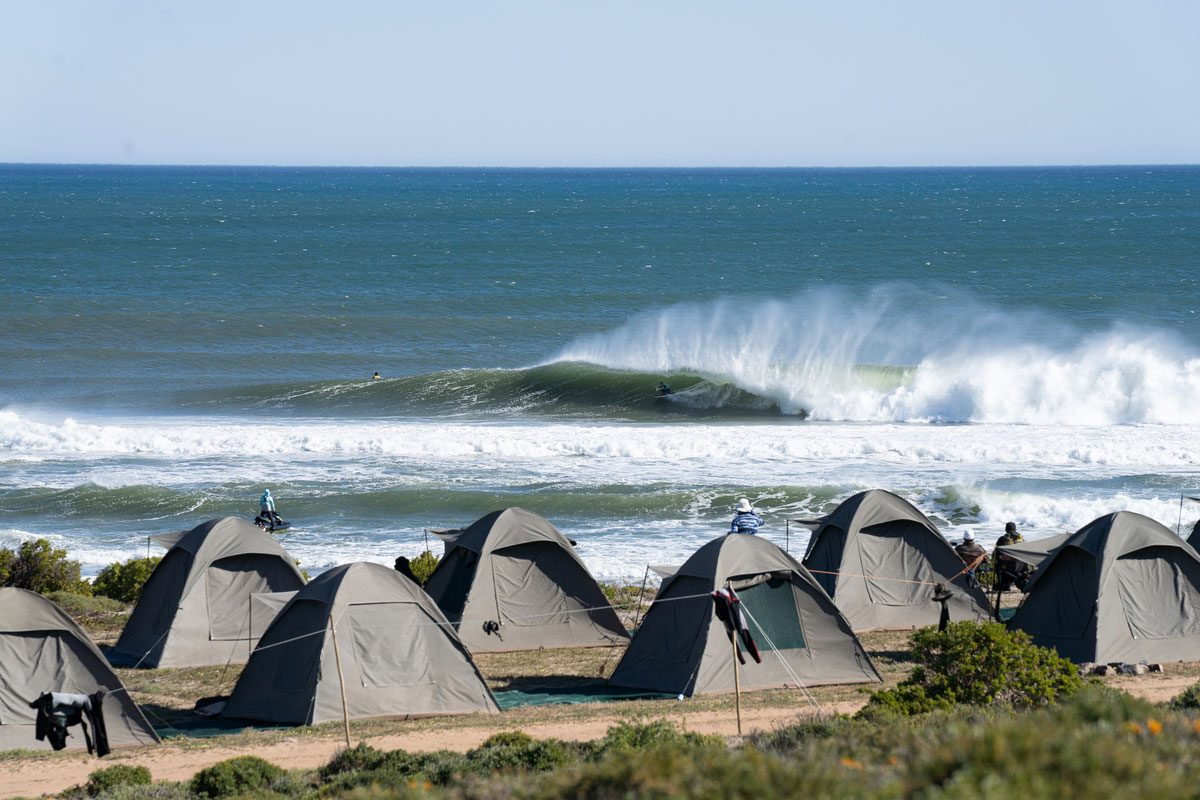
A world away from the polished, predictable contest offerings the modern surfing world is used to, there is a 40-strong crew building a small village in the middle of South Africa’s Western Cape. Six hours into the desert, in the middle of winter, with hopes of scoring a world class beach break for the latest Natural Selection contest, which sees a number of the world’s best free surfers take on one of the most unique contests in surfing.
The is just a small fraction of the groundwork required to put on Natural Selection which is due to air to the public on Friday 25 September. What sets the contest apart isn’t just the location scouting or the remoteness for its own sake. It’s the way the concept pairs genuine off-grid adventure with empty, world class waves and a scoring format that is so far removed from a traditional WSL tour stop. It’s an expedition with a scoreboard attached, and the idea didn’t come from surfing at all.
Natural Selection belongs to snowboarding icon Travis Rice, who launched the concept in 2021 by dropping elite snowboarders into genuinely wild, unmarked terrain instead of a groomed competition course. It expanded into skiing and freeride mountain biking, and last year, for the first time, into surfing. That debut played out in Micronesia, where a remote, mechanical reef-point produced heaving, sub-sea drainers that gave the contest an added layer of survival mode. Soli Bailey and Milla Brown won that inaugural event, and both return this year to defend their titles.

Getting from that founding idea to an actual event on a beach, though, takes months of quiet groundwork most fans never see. Event Director Jason Murray described the process of choosing a location as slow and deliberate by necessity.
“You’re looking at an eight month runway from the time you start ideating and looking at a particular destination to eventually pulling the trigger and then running the thing.”
The decision isn’t just about finding good waves. As Jason puts it, it comes down to three things holding equal weight:
“Whether the location can produce world-class surf, whether it carries the element of off grid adventure which helps make our contest unique and whether it’s still accessible enough to transport an operation of around 40 people and actually run it.”
South Africa’s Western Cape checked those boxes, but Jason is upfront that choosing to run there wasn’t a decision made lightly. “It’s a sensitive part of the world and we’re aware of that,” he told me, pointing to the mining activity and other industries threatening that stretch of coastline. Natural Selection has partnered with local voices to use the event as a way of amplifying awareness of those threats, rather than simply parachuting in and leaving.
Jason said there is a real respect for the fact that these waves belong to someone. “We’re also super mindful and respectful of people’s kinship to particular waves, regions and communities. We don’t want to piss anyone off.”
Once the location is locked in, the real logistics begin. For this year’s event, that meant building what was essentially a small town from scratch in the middle of nowhere. “The camp build took about five days. We literally built a small village,” said Jason.
Twenty-three livable tents, five or six outbuildings, a camp kitchen, a dining hall, an athlete lounge, a boardroom, bathrooms and showers, all assembled far off-grid, where there’s no popping down to the shop if something’s missing.
Twelve surfers and a crew of 40 spent ten days camped out waiting for the right combination of long-period swell and offshore wind, and when it finally arrived, Jason called the resulting beach break conditions among the most flawless he’s ever witnessed. “The proof is in the pudding, people will look at it and know we scored. All the surfers were incredibly stoked to get the conditions we did.”

That kind of payoff, though, sits on top of a mountain of risk that has nothing to do with performance and everything to do with logistics failing. “Production in general is just a series of problems. It’s my job as event director to solve those problems. There are challenges at every corner,” he said.
This year’s near-disaster came the night before round one, when a squall rolled through with winds hitting 50 to 60 knots and tore apart the tent the crew had built to store the athletes’ boards. “A ten by five metre tent was completely ripped in half, boards and wetsuits were flying everywhere. It looked like something out of the Wizard of the Oz,” he said.
Compared to last year’s Micronesia leg, which required a chain of planes, boats and trucks and total reliance on a small commercial airline, Jason said South Africa was more reachable, even if it came with fewer creature comforts than the surf resort the team stayed at the year before.
None of this works without the right people. Jason’s team is lean, and everyone wears multiple hats, something he credits directly to Travis’ influence. “We have a small team; we all wear a lot of hats. But it’s this idea of reckless optimism that is installed upon us by Travis Rice that keeps us believing.” The athletes need a similar mindset. Talent alone isn’t the selection criteria. “We look for the right mentality in the athletes who come and compete. We want them to embrace this sense of adventure. There are loads of surfers good enough to compete at this level, but not many would want to camp six hours deep into the desert in the middle of winter.”

It’s worth putting Natural Selection in context of where the rest of competitive surfing sits right now. The WSL runs a tightly controlled tour, built around a judging system that scores every wave out of ten. Natural Selection scraps that entirely in favour of its CREDO system, borrowed from the tour’s snow and bike events, which judges surfers on creativity, risk, execution, difficulty and overall impression, discussed openly by a judging panel rather than handed down as an anonymous number. It’s a looser, rawer product, one that trades the polish of a tour stop for the unpredictability of an actual expedition.
“Biggest takeaway for me is we’re trying to bring something different to the surf space, judging and format is unique, we’re pushing to do something fresh, we think surfers will be stoked on,” said Jason.
The surfing world will get to be the judge when the full two hour broadcast lands on Friday. Here’s who is in this year’s competition:
Men
- Soli Bailey
- Eithan Osborne
- Noah Beschen
- Eli Beukes
- Balaram Stack
- Hughie Vaughan
- Jarvis Earle
- Mikey Wright
Women
- Milla Brown
- Kirra Pinkerton
- Eden Walla
- Sanoa Dempfle-Olin